
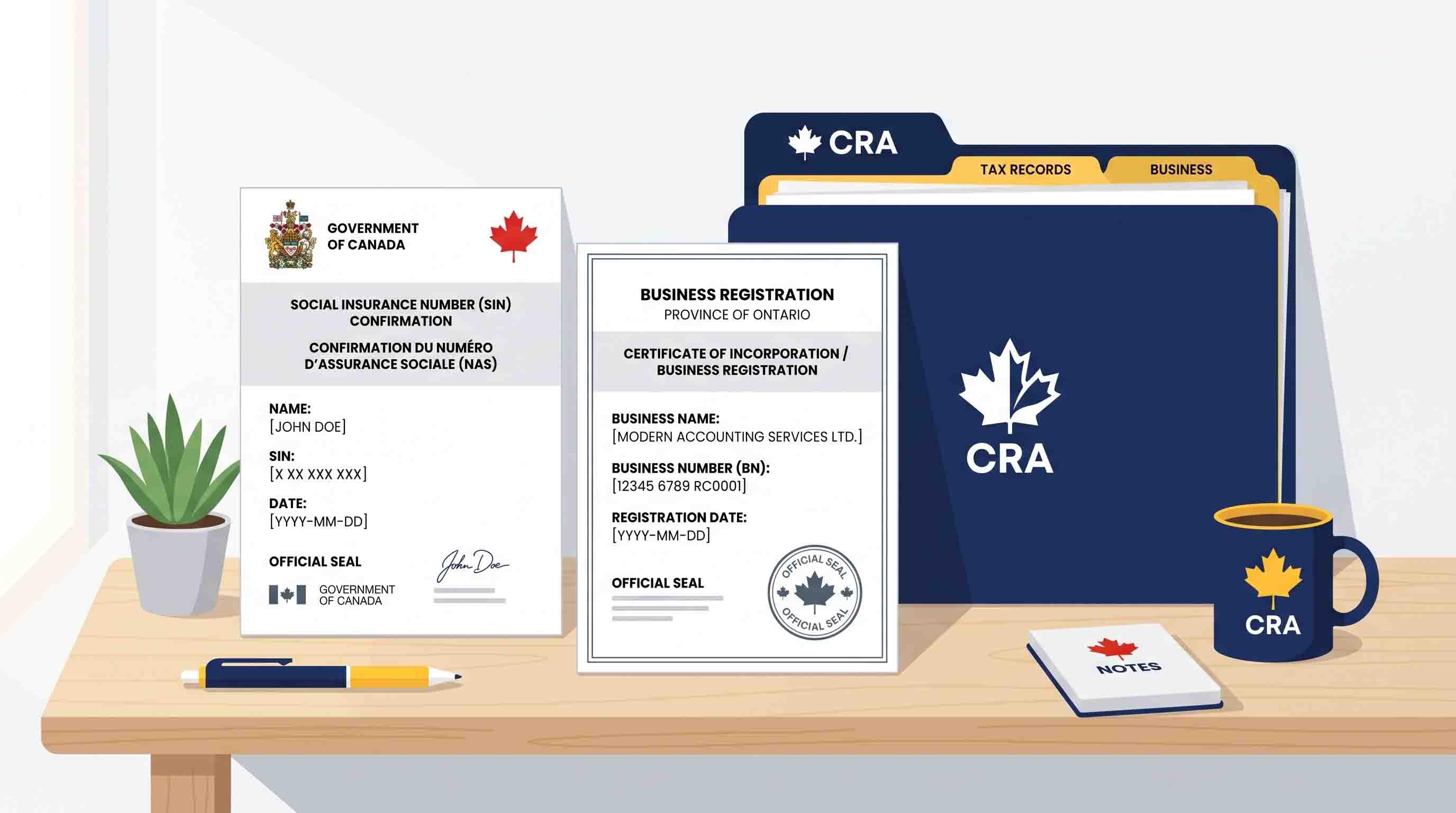
Canada does not issue a single "tax identification number" (TIN) the way some countries do. Instead, the Canada Revenue Agency (CRA) and Service Canada use a set of numbers depending on who you are: the Social Insurance Number (SIN) for individuals, the Business Number (BN) for businesses, and the Individual Tax Number (ITN) for non-residents who cannot get a SIN. When a bank, employer, or foreign tax authority asks for your "Canadian tax ID," one of these is almost always what they mean.
The confusion is understandable. The term "TIN" appears constantly on international forms, yet you will rarely see it on a CRA document. This guide clears it up: every Canadian tax ID number, what each one looks like, who needs which, how to apply, and where to find a number you already have.
Does Canada Have a Tax ID Number (TIN)?
Not as a standalone number. "TIN" is an international umbrella term used by the IRS in the U.S., on FATCA and Common Reporting Standard (CRS) forms, and by foreign banks for whatever number a country uses to identify a taxpayer. Canada uses purpose-specific numbers instead of one universal ID.
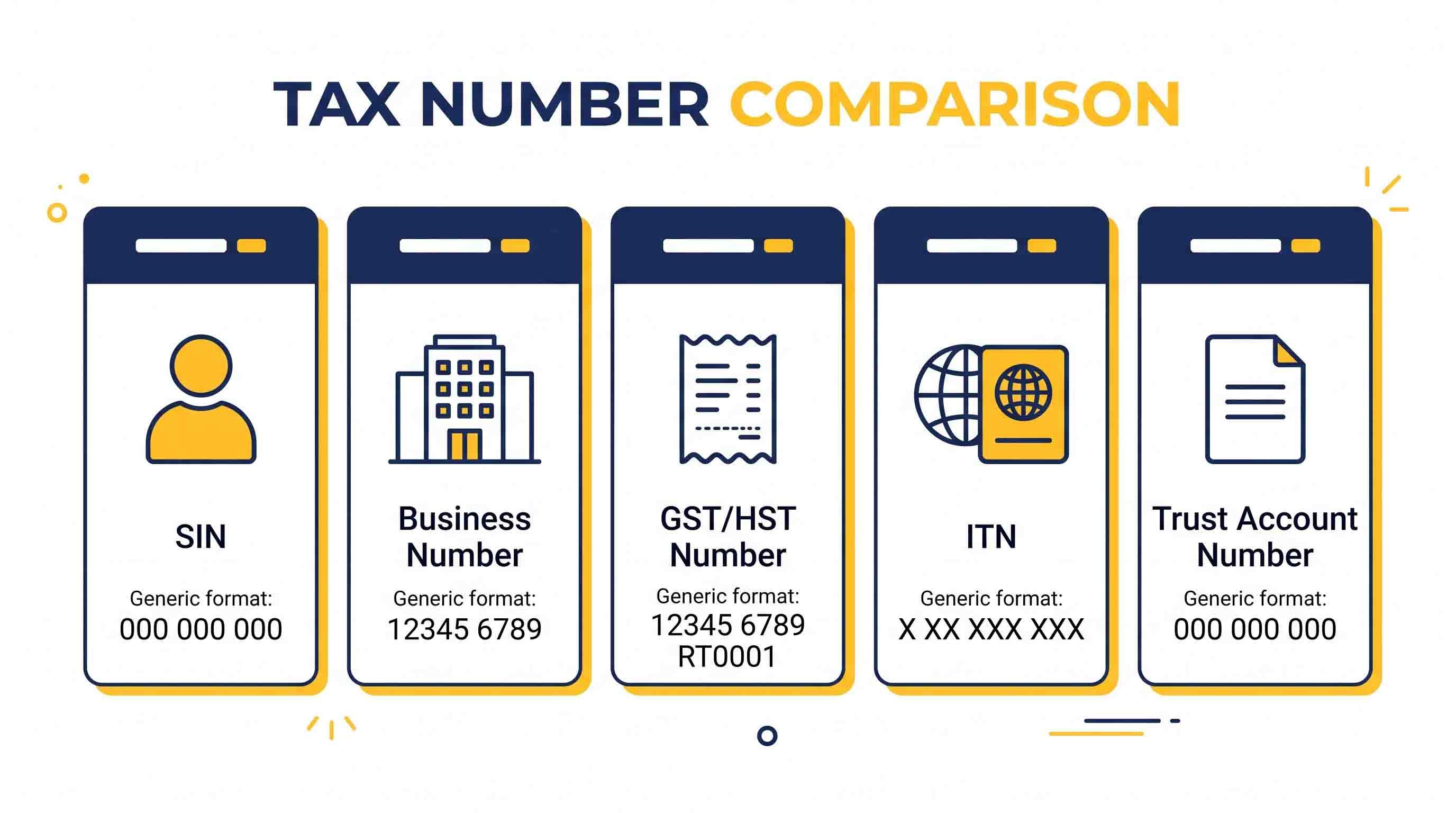
For tax-reporting and information-exchange purposes, the CRA treats these as Canada's TIN equivalents:
- Individuals: the Social Insurance Number (SIN)
- Businesses and corporations: the Business Number (BN)
- Non-residents without a SIN: the Individual Tax Number (ITN), or a Temporary Tax Number in some cases
- Trusts: a trust account number, the letter T followed by eight digits
So if a form asks for your "Canadian TIN," supply the number that matches your situation.
Canadian Tax ID Numbers at a Glance
Use this comparison as the quick answer before choosing which section applies to you.
| Number | Who it is for | Format | Issued by |
|---|---|---|---|
| SIN (Social Insurance Number) | Individuals: citizens, permanent residents, eligible temporary residents | 9 digits, written as 123-456-789 | Service Canada |
| BN (Business Number) | Businesses, corporations, sole proprietors with CRA obligations | 9 digits, written as 123456789 | CRA |
| Program account (BN15) | A specific CRA tax account attached to a BN | 9-digit BN + 2-letter program + 4-digit reference, such as 123456789 RT 0001 | CRA |
| GST/HST number | Businesses collecting sales tax | BN + RT0001 | CRA |
| ITN (Individual Tax Number) | Non-residents with Canadian tax obligations who cannot get a SIN | 9 digits | CRA |
| TTN (Temporary Tax Number) | A stopgap CRA-assigned number in limited cases | 9 digits | CRA |
| Trust account number | Trusts and estates | T + 8 digits | CRA |
Social Insurance Number (SIN)
The SIN is the tax ID number for individuals in Canada. It is a nine-digit number, written as 123-456-789, issued by Service Canada, and it follows you for life. Service Canada describes the SIN as the number you need to work in Canada or access government programs and benefits.
- Start a job. Your employer must collect it for payroll and to issue your T4.
- File a personal income tax return.
- Receive government benefits such as the Canada Child Benefit, GST/HST credit, or Employment Insurance.
- Open interest-bearing or investment accounts, where the institution reports income to the CRA under your SIN.
Temporary residents
Workers and students on permits receive a SIN that begins with 9 and carries an expiry date tied to their permit.
No more SIN cards
Physical SIN cards are no longer issued. You receive a confirmation letter instead.
Confidential number
Your SIN is confidential, but employers and financial institutions need it for legal tax-reporting purposes.
You can apply for a SIN online, by mail, or in person through Service Canada's SIN application page.
Business Number (BN): And Why It Is Only Half the Story
The Business Number is the tax ID for businesses. It is a nine-digit number issued by the CRA that acts as the single root identifier linking your business to federal, provincial, and many municipal programs.
Here is the part that trips up many business owners: the BN by itself is not a working tax account. It is the anchor. To actually file GST/HST, run payroll, or file a corporate return, you register a program account that attaches to your BN. One BN can support many program accounts.
CRA Program Accounts: The 15-Character Full Tax ID
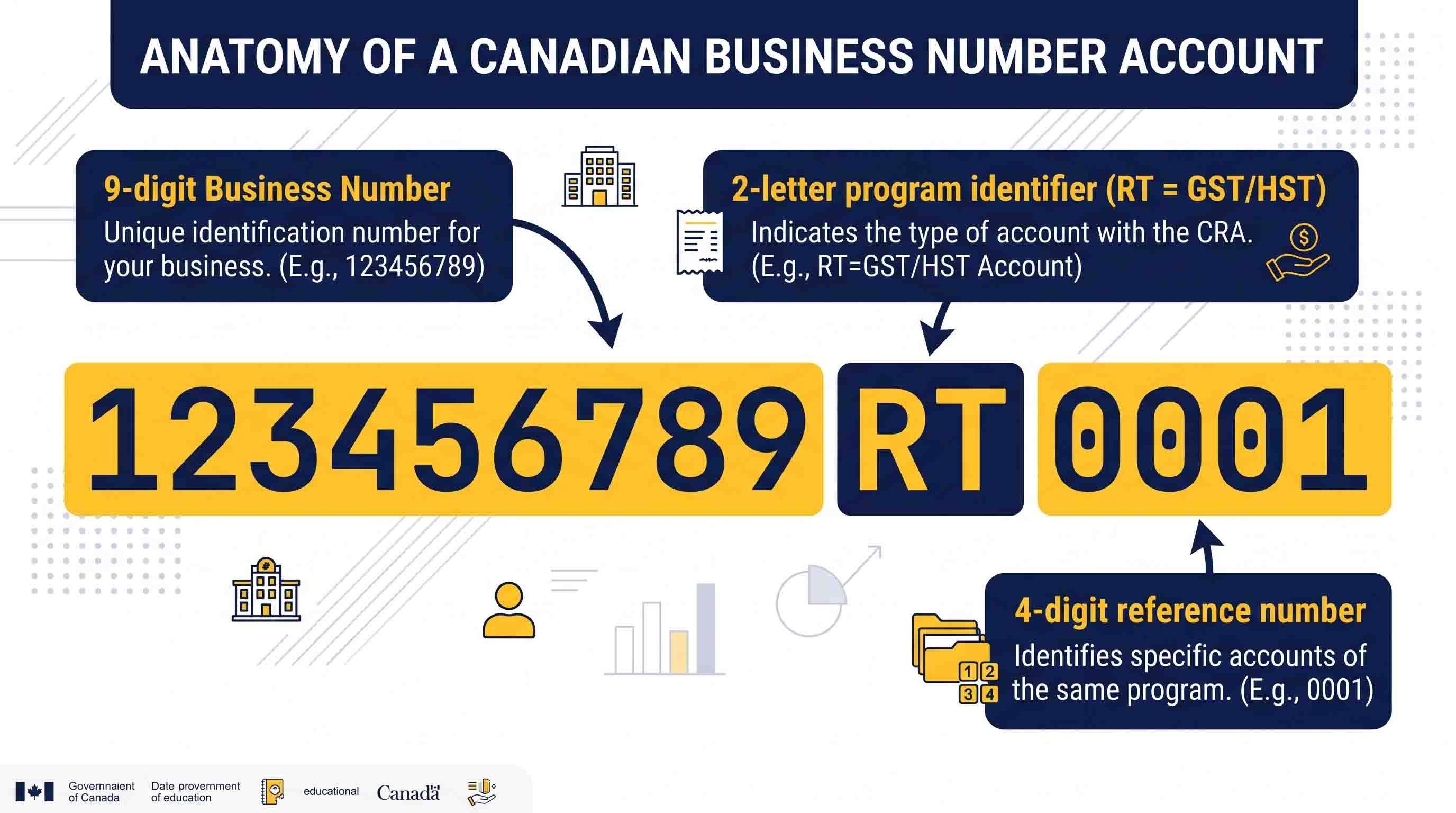
When someone gives you a number like 123456789 RT 0001, that is a program account. It is sometimes called the BN15 because it is 15 characters long. It has three parts:
01
The 9-digit BN
Identifies your business, such as 123456789.
02
Program identifier
Two letters that say which kind of tax account it is.
03
Reference number
Four digits that distinguish multiple accounts of the same type, such as 0001 or 0002.
Common CRA Program Identifiers
| Program identifier | Account type | What it is for |
|---|---|---|
| RT | GST/HST | Collecting and remitting sales tax |
| RP | Payroll deductions | Withholding and remitting income tax, CPP, and EI for employees. T4, T4A |
| RC | Corporate income tax | Filing the T2 corporate return |
| RZ | Information returns | Filing slips such as T5, T5013, and T5018 |
| RM | Import-export | Importing or exporting goods |
A single corporation might hold 123456789 RC 0001 for corporate taxes, 123456789 RT 0001 for GST/HST, and 123456789 RP 0001 for payroll. Each account is registered separately. Having a GST/HST account does not automatically create a payroll account.
Your GST/HST Number (RT) and the $30,000 Threshold
Your GST/HST number is your BN plus the RT program account, such as 123456789RT0001. You are required to register once your business earns more than $30,000 in taxable revenue over four consecutive calendar quarters, or in a single quarter. Below that small supplier threshold, registration is optional, but many businesses register voluntarily so they can claim input tax credits (ITCs) on their expenses.
This RT number is what you must show on invoices of $100 or more so your customers can claim their own ITCs. The CRA also notes that if you do not already have a BN when you register for GST/HST, you receive one at the same time as your GST/HST account registration.
You can read the current CRA process on the CRA GST/HST registration page.
Payroll (RP), Corporate Income Tax (RC), and Information Returns (RZ)
If you hire employees, you need an RP account to remit source deductions. If you incorporate, you need an RC account to file your T2. And if you issue slips, for example a corporation paying dividends on a T5 or issuing T4As, you may need an RZ information-return account. Registering the wrong account, or missing one, is a common cause of misfiled returns and penalties.
Individual Tax Number (ITN) for Non-Residents
The ITN is the tax ID for non-residents who have a Canadian tax obligation but are not eligible for a SIN. It is a nine-digit number issued by the CRA, and you apply using Form T1261, mailed to the CRA. Processing typically takes six to eight weeks, so apply well ahead of any deadline.
You will generally need an ITN if you are a non-resident who:
- Earns Canadian rental, investment, or employment income
- Owns or is selling Canadian property
- Needs to file a Canadian return for any other reason
The ITN matters most in real estate. When a non-resident sells Canadian property, the buyer must withhold 25% of the gross sale price under Section 116 of the Income Tax Act until the CRA issues a clearance certificate, and you cannot get that certificate without an ITN on file. This is where non-residents most often run into trouble, and it is worth planning for months in advance.
The CRA publishes the current form on its T1261 Individual Tax Number page.
Temporary Tax Number (TTN)
In limited situations, the CRA assigns a Temporary Tax Number. It is a nine-digit stopgap used to process a filing while a permanent number, usually an ITN, is being obtained. A TTN is not something you choose. It is issued by the CRA when needed. Once your permanent number arrives, records should be updated to avoid future mismatches.
Trust Account Number
Trusts and estates are identified by a trust account number, the letter T followed by eight digits, issued by the CRA. This is the trust's TIN equivalent for filing the T3 return and for information-exchange purposes.
How to Find a Tax ID Number You Already Have
If you know your number exists but cannot locate it, start with the source that matches the number.
SIN
Check a prior tax return, your CRA My Account profile, a T4 slip, or your original SIN confirmation letter.
BN and program accounts
Look in CRA My Business Account, CRA notices, past GST/HST or payroll filings, or a prior T2 return.
GST/HST number
Check your invoices, GST/HST registration confirmation, or My Business Account. You can also confirm another business through the CRA GST/HST Registry.
If a number has genuinely been lost or you are unsure which account you hold, your accountant can retrieve it through CRA's Represent a Client portal.
How to Apply for Each Tax ID Number
SIN
Apply through Service Canada online, by mail, or in person with original identity and status documents such as a birth certificate, passport, PR card, or permit. It is free.
Business Number and program accounts
Register through Business Registration Online (BRO), which usually issues your BN immediately. You are often assigned a BN automatically when you incorporate federally or in most provinces, or when you first register for GST/HST or payroll. As of November 3, 2025, the CRA no longer accepts business number registrations by phone. Use the online service or have your accountant register on your behalf. Registering a BN and its program accounts is free.
ITN
Submit Form T1261 with certified copies of your identity documents to the CRA. Allow six to eight weeks. It is free.
All of these are free directly from the government. You only pay if you hire someone to manage the process for you. CRA business registration details are available on the Business number and CRA program accounts page.
Which Tax ID Number Do You Actually Need?
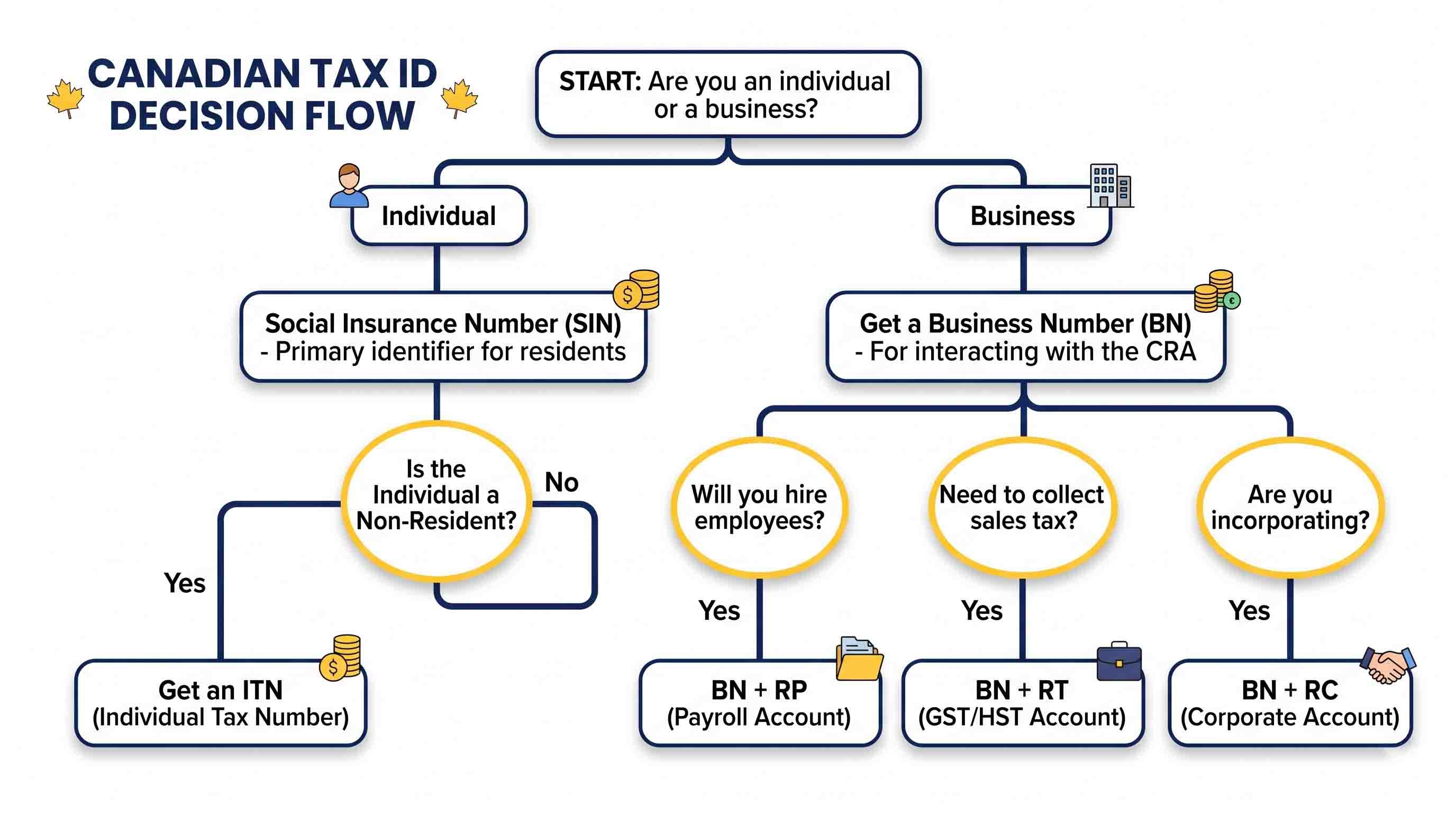
You are an employee or filing a personal return: SIN
You are a non-resident with Canadian income or property: ITN
You are starting a sole proprietorship and crossing $30,000 in revenue: BN with a GST/HST (RT) account
You are hiring your first employee: BN with a payroll (RP) account
You are incorporating: BN with a corporate income tax (RC) account, plus RT/RP as needed
Your corporation is paying dividends or issuing slips: BN with an information-return (RZ) account
You are administering a trust or estate: trust account number
Protecting Your Tax ID Number From Scams
Your SIN and BN are prime targets for identity theft, and CRA impersonation scams spike every tax season. Two rules to keep in mind: the CRA will never ask for your SIN by email or text, and you should only share these numbers when there is a genuine legal reason. Store confirmation letters securely, verify any request through official CRA channels rather than links in messages, and report suspected misuse to the CRA and police immediately.
How Invisor Helps You Get Your Numbers Right
Registering the correct CRA program accounts and keeping them straight at filing time is exactly where new and growing businesses lose time and money.
At Invisor, we register Business Numbers, GST/HST, payroll, and corporate tax accounts for clients across Ontario and beyond, make sure non-residents have the right ITN in place before a property sale or filing deadline, and keep every account compliant year-round.
Book a consultationFrequently Asked Questions
Quick answers to the tax ID number questions people most often ask in Canada.
Does Canada have a tax identification number (TIN)?
Not as a single number. Canada uses the SIN for individuals, the Business Number for businesses, and the ITN for non-residents who cannot get a SIN. On international forms, you provide whichever of these applies to you.
What is a Canadian tax ID number for an individual?
For most individuals it is the Social Insurance Number (SIN), a nine-digit number issued by Service Canada that you use for employment, filing taxes, and accessing benefits.
Is a Business Number the same as a GST/HST number?
Not exactly. The Business Number, or BN, is the 9-digit root identifier. Your GST/HST number is that BN plus the RT program account, written as 123456789RT0001.
What do the letters RT, RP, RC, and RZ mean?
They are CRA program identifiers attached to your Business Number: RT is GST/HST, RP is payroll deductions, RC is corporate income tax, and RZ is information returns such as T5 and T4A slips.
How do I get a tax ID number in Canada?
Apply for a SIN through Service Canada, a Business Number and program accounts through CRA Business Registration Online, and an ITN by filing Form T1261. All are free directly from the government.
How much does a Canadian tax ID number cost?
Nothing. The SIN, BN, GST/HST account, and ITN are all free from Service Canada or the CRA. You only pay if you use a third party to handle the application.
What tax ID do non-residents of Canada use?
Non-residents who cannot get a SIN use an Individual Tax Number (ITN), obtained by filing Form T1261. It is essential before selling Canadian property because of the 25% withholding under Section 116.
How long does it take to get a Business Number or ITN?
A Business Number through Business Registration Online is usually issued immediately. An ITN typically takes six to eight weeks to process.
Where can I find my Business Number?
In CRA My Business Account, on any CRA notice, on past GST/HST or payroll filings, or on a prior T2 corporate return.
Can I register a Business Number by phone?
No longer. As of November 3, 2025, the CRA stopped accepting business number registrations by phone. Register online or through an authorized representative.